
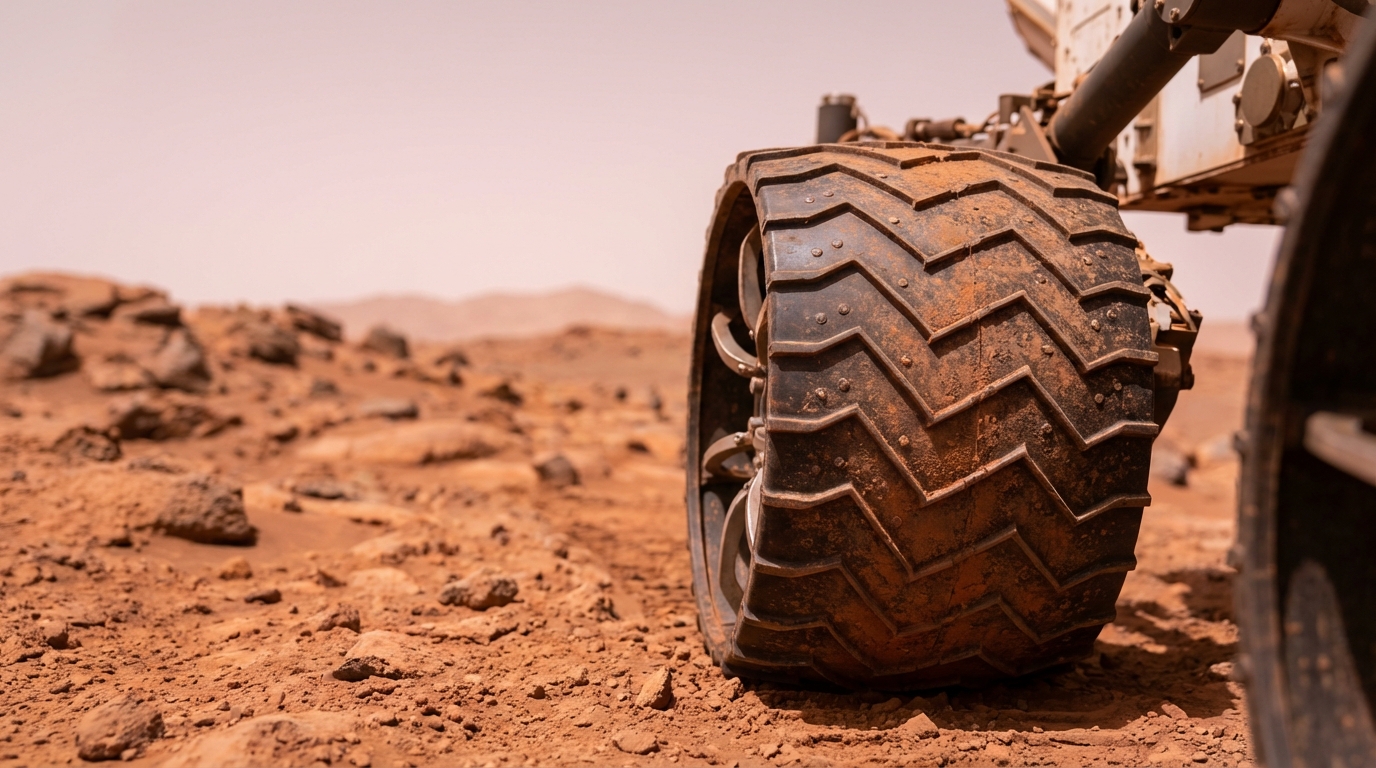
After five years and 40 kilometers on the red planet, the Perseverance rover has just been cleared for an epic new chapter in its journey across Mars. While originally designed for just two years of service, NASA now confirms its robotic explorer could travel an astonishing 60 kilometers more, a distance that would shatter all previous records for off-world driving. How can a machine survive for so long in such a hostile environment, and what incredible discoveries await on this unprecedented trek? The answer lies in a combination of brilliant engineering and a recent, crucial verdict from its creators back on earth.
A rover built to break every limit
Nearly five years have passed since Perseverance first touched down on Mars in February 2021. Since then, the car-sized rover from NASA has been anything but idle, even if its progress is methodically slow. Frequent stops for scientific measurements and sample collection have punctuated its journey, but this tireless explorer has already covered an impressive 40 kilometers, a testament to the vision of its makers.
Morgane Gillard, 37, a geologist and journalist, feels a deep connection to the mission. “Watching Perseverance’s journey is like reading the planet’s diary. Each rock sample is a word, each kilometer a sentence in a story billions of years old.” For her, following the work of the space agency rekindles the same magic she felt as a child watching comets, a link between a personal passion and the grand scale of cosmic exploration.
This journey far exceeds the initial expectations. The original mission was guaranteed for only two earth years, a standard benchmark. Yet, this titan of space exploration has proven its durability, pushing the boundaries of what was thought possible for robotic missions.
The treacherous path from Jezero to Charmes lake
Perseverance’s trek has been far from a simple drive. Its route first took it across the floor of Jezero crater before leading it up the steep crater rim. Today, the rover has moved beyond that initial zone and is making its way toward extremely ancient landscapes in an area known as the Charmes Lake region, a destination chosen by mission control for its scientific promise.
The Martian surface is a minefield of hazards. The landscape is littered with sharp rocks, scattered boulders, and patches of loose sand that could easily trap a less capable machine. Ravines and uneven ground pose constant challenges, demanding careful navigation from the rover’s handlers on earth.
So far, Perseverance has managed to avoid most of these dangers thanks to its advanced autonomous navigation system. “More than 90% of Perseverance’s journey so far has relied on autonomous driving, which has allowed it to collect a large number of samples efficiently,” explains Hiro Ono, a researcher at NASA’s Jet Propulsion Laboratory. This allows the architects of Martian exploration to cover more ground safely.
The verdict from earth: how far can perseverance really go?
The key question for the team back on earth was how long the rover could continue operating under such demanding conditions. Even though Perseverance currently appears to be in excellent condition, engineers at the space agency felt it was crucial to carry out a thorough check of its core components, especially the wheel axles, to ensure they could endure the continued strain.
To get a definitive answer, the administration conducted exhaustive tests on earth last summer, simulating the wear and tear of many more kilometers on Martian terrain. These tests were designed to push replica components to their breaking point, providing invaluable data for the future of the mission. The guardians of this off-world emissary needed to be certain before committing to a more ambitious path.
A new chapter in martian exploration
The verdict from these intensive tests is incredibly encouraging. The masterminds behind the mission now believe Perseverance should have no trouble pressing on. More than that, they are confident it is capable of traveling an additional 60 kilometers. This decision by NASA effectively transforms the entire scope of the mission.
If successful, this extension will bring the rover’s total travel distance to 100 kilometers. This isn’t just an incremental increase; it elevates the mission from a localized investigation of Jezero crater to a grand, regional-scale geological survey of Mars. This is precisely the ambitious goal the celestial explorers had hoped for.
| Feature | Original mission (2021-2023) | Extended mission (2026 onwards) |
|---|---|---|
| Guaranteed duration | 2 earth years | 5+ additional years (projected) |
| Target distance | ~15-20 kilometers | Up to 100 kilometers total (40+60) |
| Primary zone | Jezero crater floor & delta | Beyond the crater rim, Charmes lake region |
| Scientific scope | Search for ancient life in a specific lakebed | Regional geological survey across diverse ancient terrains |
What discoveries await on this epic martian road trip?
This extended journey opens up a universe of scientific possibilities. The new target zones, like the Charmes Lake region, contain some of the oldest and most intriguing geological formations ever identified on Mars. The exploration team is eager to analyze rocks that could hold secrets about the planet’s very distant past, a time when it may have been more habitable.
The core objective of the NASA mission remains the search for biosignatures—telltale signs of ancient microbial life. Each new landscape offers a fresh opportunity to find that definitive clue. The rover will continue to drill into promising rocks, analyzing their composition and storing core samples for a potential future mission to return them to earth for study.
This ambitious plan, greenlit by the national aeronautics and space administration, is a crucial step in that long-term sample return strategy. The more diverse the collection of samples, the higher the chance of making a historic discovery once they arrive in terrestrial labs.
More than a machine, a symbol of human curiosity
Ultimately, Perseverance represents more than just a collection of circuits and sensors. Like its predecessor Curiosity, which also continues to explore Mars, this rover is a physical extension of humanity’s innate drive to explore the unknown. It is our eyes, hands, and scientific instruments on a world millions of kilometers away.
The journey ahead is long and filled with challenges, but the potential rewards are immeasurable. As this robotic pioneer pushes deeper into uncharted Martian territory, it carries with it the hopes and dreams of millions. The cosmic storytellers at NASA are writing a new chapter in our understanding of the solar system, and thanks to Perseverance, Mars could continue to surprise us for many years to come.
How long has the Perseverance rover been on Mars?
As of early 2026, the Perseverance rover has been exploring Mars for nearly five years, having landed in February 2021. It has already operated far beyond its initial two-year primary mission warranty.
What is the main goal of the Perseverance mission?
The primary objective of the NASA mission is to seek signs of ancient microbial life. It also collects and caches rock and soil samples for a potential future mission to return them to Earth for in-depth analysis.
How does Perseverance drive on its own?
Perseverance uses an advanced autonomous navigation system called AutoNav. This technology allows the rover to use its cameras to create 3d maps of the terrain ahead, identify potential hazards like large rocks or sand traps, and plan a safe path without constant input from mission control on Earth.
What is the total distance Perseverance is expected to travel?
After already covering 40 kilometers, NASA engineers have certified Perseverance to travel up to 60 additional kilometers. This brings its potential total journey to an unprecedented 100 kilometers on the Martian surface, making it the farthest-traveling rover on another planet.