
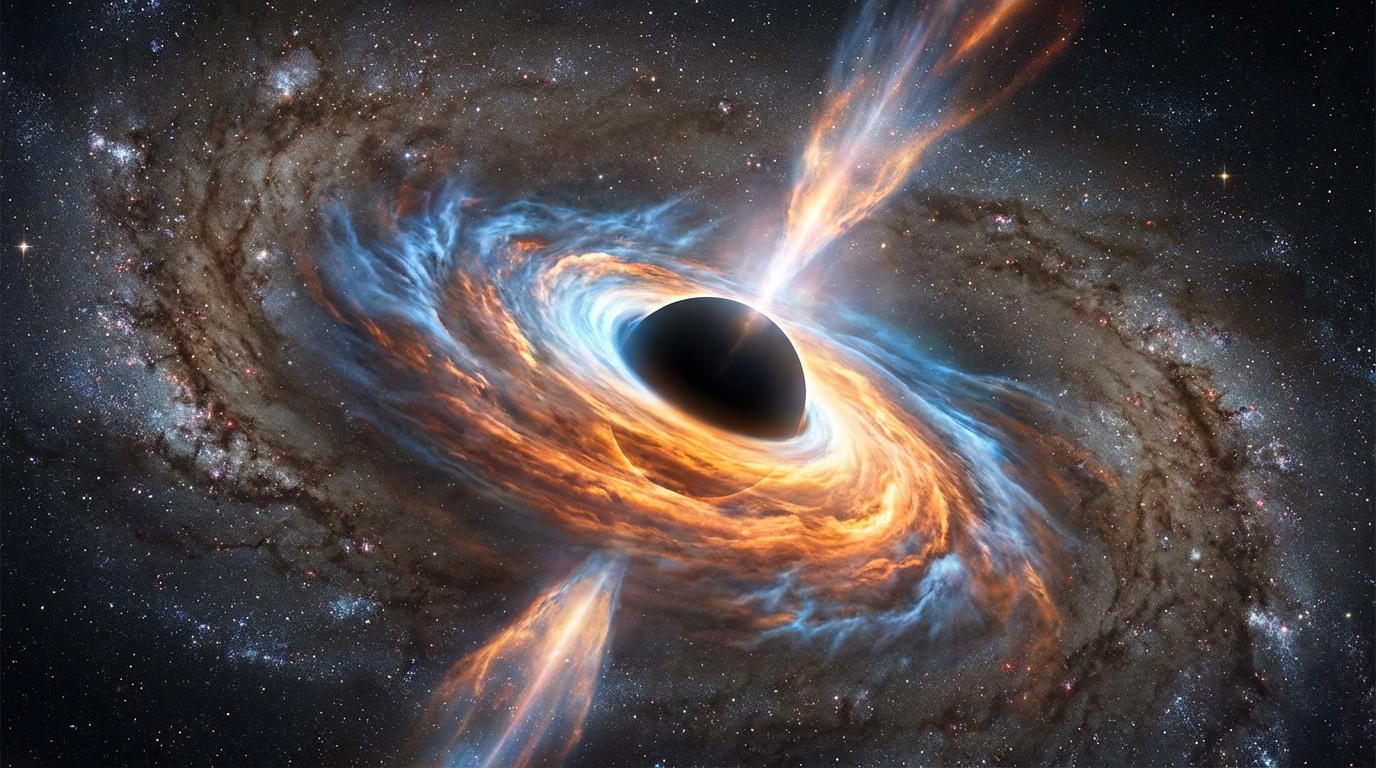
In the heart of a galaxy once thought to be a picture of serene perfection, astronomers have just witnessed an eruption of unimaginable power, blasting matter outwards at nearly 60,000 kilometers per second. Even more startling is that the violent physics behind this cosmic storm bear a shocking resemblance to the solar flares produced by our very own sun. This unexpected connection between a distant black hole and our star is forcing a major rethink of how the universe works. What could possibly link these two vastly different celestial objects?
A violent secret hidden in a perfect spiral
From our vantage point, the galaxy NGC 3783 appears as a graceful, perfectly formed spiral, a calm swirl of stars floating in the silent darkness of space. Located approximately 155 million light-years away, this celestial body, much like our own Milky Way, has long been an object of admiration. But recent observations have shattered this peaceful image, revealing a tempest of staggering proportions raging within its core, a discovery that fundamentally alters our perception of galactic dynamics.
Liam Carter, 22, a physics student from Manchester, shared his astonishment. “I always saw galaxies as these serene, distant islands of light. To learn that something so beautiful hides a storm moving at a fraction of light speed… it’s both terrifying and absolutely exhilarating.” This finding from the field of astronomy highlights the raw, violent power that shapes our universe.
The groundbreaking discovery was made by a team of researchers from the Space Research Organisation Netherlands (SRON). Their work, published in the journal Astronomy & Astrophysics, details a stunning sequence of events that challenges long-held assumptions in the study of the heavens. This new chapter in celestial cartography was written by combining the power of two of humanity’s greatest eyes on the sky.
The telescopes that pierced the cosmic veil
To peer into the heart of NGC 3783, scientists needed a special kind of vision. They used the European Space Agency’s XMM-Newton Space Telescope, a veteran of cosmic exploration since 1999, alongside the newer X-Ray Imaging and Spectroscopy Mission (XRISM), a joint effort by JAXA, ESA, and NASA launched in September 2023. Both instruments observe the universe in X-rays, allowing them to see the hottest and most extreme phenomena that are invisible to optical telescopes.
What they saw was astonishing. First, a brilliant and intense burst of X-rays erupted from the galaxy’s center, only to vanish almost as quickly as it appeared. This was immediately followed by the detection of colossal winds, a cosmic hurricane of matter being ejected from the core. This event provides a fascinating look into the powerful mechanics of our cosmos.
The engine of chaos at the galaxy’s core
At the center of this galactic storm lies a true heavyweight: a supermassive black hole roughly 30 million times the mass of our sun. This behemoth is not dormant; it actively feeds on a swirling disk of nearby gas and dust, creating an incredibly bright and energetic region known as an active galactic nucleus, or AGN. These AGNs are the powerhouses of galaxies, emitting radiation across the entire electromagnetic spectrum.
The SRON scientists believe the tremendous winds were unleashed by a cataclysmic magnetic event. As the magnetic field lines around the black hole became twisted and tangled, they suddenly snapped and reconnected, releasing a colossal amount of stored energy. This process is a key focus of modern astronomy, as it appears to be a universal mechanism for energy release.
This dramatic unfolding is more than just a spectacle; it’s a crucial piece of evidence in the grand puzzle of the universe. Understanding such phenomena is central to the entire discipline of astronomy and how we comprehend the forces that govern the cosmos.
A cosmic tempest of unimaginable scale
The sheer velocity of the observed winds is difficult to comprehend. At nearly 60,000 kilometers per second, this outflow is moving at about one-fifth the speed of light. Matter ejected at such speeds can traverse vast cosmic distances, profoundly influencing the evolution of the host galaxy. This observation is a testament to the extreme physics at play in the grand celestial theater and a thrilling discovery for astronomers.
This event underscores the dynamic and often violent nature of the universe, a central theme in the science of stargazing. It reminds us that even objects that appear static and serene are part of a constantly evolving cosmic ballet.
A surprising link to our very own sun
While a supermassive black hole might seem completely alien, the physics behind its outburst is surprisingly familiar. Our own sun frequently unleashes similar, albeit much smaller, events. Massive solar flares can hurl scorching clouds of magnetized plasma into space in what are known as coronal mass ejections (CMEs). The science of the stars connects these two seemingly disparate events.
On November 11, 2025, a particularly strong CME was recorded with particles traveling at speeds of about 1,500 km/s. While impressive, this is dwarfed by the 60,000 km/s winds from NGC 3783. Yet, the underlying mechanism—the sudden release of energy from reconfiguring magnetic fields—is strikingly similar. This parallel has profound implications for the field of astronomy.
Erik Kuulkers, an XMM-Newton project scientist at ESA, highlighted the significance of this connection. “By observing an active supermassive black hole, XMM-Newton and XRISM have revealed a brand-new phenomenon… These winds resemble those we see from the sun. Fascinatingly, this suggests that solar and high-energy processes might operate in remarkably similar ways throughout the universe.”
| Feature | NGC 3783 Black Hole Event | Solar Coronal Mass Ejection (CME) |
|---|---|---|
| Location | Core of a distant spiral galaxy | Surface of our Sun |
| Central Object | 30 million solar mass black hole | The Sun (1 solar mass) |
| Outflow Speed | Approximately 60,000 km/s | Up to 1,500 km/s for strong events |
| Driving Mechanism | Magnetic field reconnection | Magnetic field reconnection |
| Scale of Impact | Galactic | Solar System |
Why this discovery changes our understanding of the universe
The fascination with AGNs goes far beyond academic curiosity. Astronomers understand that these turbulent cosmic engines play a critical role in the life cycle of galaxies. The powerful winds they generate can push gas out of a galaxy, halting star formation, or compress gas clouds elsewhere, triggering new waves of star birth. They are the great sculptors of the cosmos.
Understanding how magnetism in these regions generates such powerful outflows could be the key to decoding the grand story of how galaxies form and evolve across billions of years. This discovery adds a vital new piece to the puzzle, bridging a gap between stellar astrophysics and high-energy galactic phenomena. It is a landmark moment for the entire discipline of astronomy.
This finding enriches the entire art of cosmic observation, showing that the same fundamental laws of physics are at work from our own backyard to the most distant reaches of space. It’s a humbling and inspiring realization that deepens our connection to the great cosmic ocean and pushes the boundaries of astronomy itself.
What is an Active Galactic Nucleus (AGN)?
An Active Galactic Nucleus (AGN) is an extremely bright and compact region at the center of a galaxy, powered by a supermassive black hole actively feeding on surrounding gas and dust. This process releases enormous amounts of energy across the entire electromagnetic spectrum.
How fast were the winds from NGC 3783’s black hole?
The winds detected erupting from the core of galaxy NGC 3783 were measured at an astonishing speed of nearly 60,000 kilometers per second. This is approximately 20% of the speed of light.
What telescopes were used for this discovery?
This discovery was made possible by combining data from two powerful X-ray observatories: the European Space Agency’s XMM-Newton Space Telescope and the X-Ray Imaging and Spectroscopy Mission (XRISM), which is a collaboration between JAXA, ESA, and NASA.
How is this event similar to a solar flare?
Although vastly different in scale, the event at NGC 3783 is believed to be driven by the same physical mechanism as a solar flare: the sudden and violent reconnection of magnetic field lines, which releases immense stored energy.
Why is understanding this phenomenon important for astronomy?
Understanding these powerful outflows is crucial for astronomy because they play a key role in galaxy evolution. These winds can regulate star formation by either clearing out the gas needed for new stars or by compressing it to trigger star birth, effectively shaping the destiny of their host galaxy.