
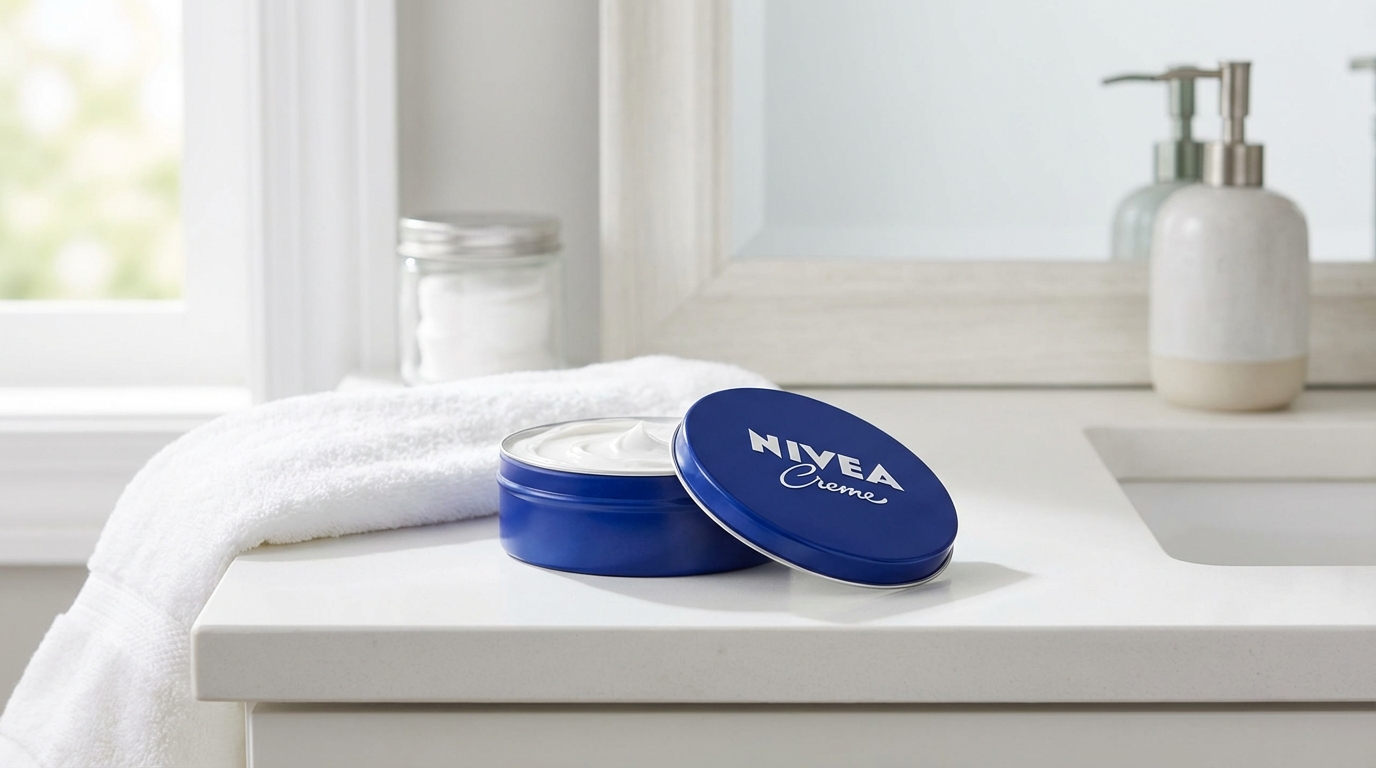
Launched in 1911, the famous Nivea cream is a powerhouse of hydration, yet its mineral oil-based formula is now considered too occlusive for many, especially oily skin types. Surprisingly, the issue isn’t its simplicity but its one-size-fits-all claim. So how can this cult classic be both an essential ally and a potential foe for your face? We’ve analyzed its composition to understand what it really does to your epidermis.
What’s really hiding inside the cult Nivea formula?
At the heart of Nivea’s success is a formula that has remained almost unchanged for over a century, a symbol of trust for millions. Its foundation relies on simple, well-known ingredients: water, liquid paraffin, glycerin, and a distinctive fragrance that has defined generations. This blend was engineered to create a robust protective barrier, preventing moisture from evaporating off the skin.
Justine L., 32, an architect from Bordeaux, shares her experience: “I wanted to try the famous blue pot on my face during winter, thinking its richness would be perfect. After a week, despite an immediate feeling of comfort, I started seeing small pimples on my cheeks.” Her story perfectly illustrates the two-sided nature of this iconic cream.
Decoding the key ingredients of the beloved formula
The strength of Nivea cream lies in its film-forming action. Mineral oils and paraffin, which are occlusive agents, form a film on the skin’s surface. This protective layer is highly effective at shielding the epidermis from external aggressors like cold and wind while maintaining a good level of internal hydration.
Glycerin, a powerful humectant, draws water into the upper layers of the skin, reinforcing this moisturizing effect. However, it is this very occlusive nature that can be problematic. This blue treasure, so beneficial for some, requires a keen understanding of its components to be used wisely. The German brand Beiersdorf has always banked on this reassuring simplicity.
The secret to its effectiveness on dry skin
For dry, dehydrated, or rough skin, Nivea cream is often seen as a true savior. This comforting balm provides almost instant relief, deeply nourishes, and restores suppleness to the roughest areas like elbows, knees, or heels. In winter, it becomes a cocoon of softness for faces exposed to low temperatures.
Its rich and creamy texture envelops the skin in a protective veil that lasts for hours. This is why this timeless classic remains an essential product for soothing tightness and repairing skin weakened by the climate. The original formula was designed precisely for this kind of urgent and intense need.
Is the blue cream a false friend for certain skin types?
Despite its undeniable qualities, the universality of Nivea cream is being called into question. The protective film it leaves, so beneficial for dry skin, can turn into a trap for other skin types. Understanding its limitations is key to avoiding disappointment and enjoying only its benefits.
The legacy of Beiersdorf’s creation is powerful, but the “clean beauty” movement of recent years has prompted consumers to examine labels more closely. The simplicity of the century-old formula now clashes with a demand for more targeted, non-comedogenic care, especially for facial application.
Oily and combination skin: why caution is advised
For those with oily or combination skin, using this household staple on the face is often ill-advised. Its occlusive effect can clog pores, trapping sebum, impurities, and bacteria. This phenomenon encourages the appearance of comedones, blackheads, and acne breakouts.
The very rich texture of this cult product can also leave a greasy and shiny finish, which is not appreciated by those already battling excess sebum. The little blue pot of comfort then becomes counterproductive, weighing down the skin instead of enhancing it. It is therefore better to reserve it for body areas less prone to imperfections.
What dermatologists think about the iconic pot
Skin experts are often unanimous: the classic cream is an excellent body moisturizer but not a universal facial treatment. Many dermatologists point out that it does not address any specific skin concerns like wrinkles, dark spots, or acne. Its role is limited to hydration and protection.
They recommend integrating this German brand’s product into a more comprehensive skincare routine and not using it alone continuously on the face, except in cases of extreme and temporary dryness. The general opinion is that the legendary product remains a must-have, but for targeted and appropriate uses.
| Skin type | Benefits of nivea cream | Potential drawbacks |
|---|---|---|
| Very dry skin | Intense hydration, repairs rough areas, strong protective barrier. | May be insufficient for dermatological conditions like severe eczema. |
| Sensitive skin | Soothes tightness, protects from cold and wind. | The fragrance and lanolin can be allergens for some highly reactive skins. |
| Combination to oily skin | Very effective on dry body areas (elbows, knees). | Comedogenic, can clog facial pores and cause breakouts. |
| Acne-prone skin | No specific benefits for this issue. | Strongly discouraged due to its occlusive nature which can worsen acne. |
The future of the skincare product amidst new consumer expectations
Faced with a growing demand for more natural and ethical products, the Nivea brand could not stand still. Consumer pressure for “clean” formulas has pushed the German giant to rethink its flagship product to adapt to the standards of 2026, without disowning its heritage.
This evolution shows that even an icon can and must reinvent itself. The universal care star thus proves its ability to listen to its audience and evolve its offering to remain relevant in a constantly changing cosmetics market.
A 100% natural and vegan version: Nivea’s response
Earlier this year, Beiersdorf made a big splash by launching a new version of its iconic cream. Formulated with 99% ingredients of natural origin and completely vegan, it directly addresses new aspirations. This variant replaces mineral oils with vegetable oils like sunflower and shea.
Currently distributed only in Germany, this initiative shows Nivea’s desire to modernize its image. This velvety embrace is now evolving to attract a new generation concerned about the environment and the composition of the products they apply to their skin.
How to use the classic Nivea cream properly in 2026
So, should we abandon the original formula? Certainly not. The timeless skincare icon retains all its relevance for specific uses. It excels as a treatment for hands and cuticles, a repairing balm for dry feet and cracked heels, or to soothe the skin after sun exposure.
It can also be used as an express hydrating face mask, to be rinsed off after about ten minutes. In short, Proust’s cosmetic madeleine from our childhood is not obsolete; we just need to see it as a specialized tool in our beauty arsenal rather than a one-stop solution.
Is Nivea cream comedogenic?
Yes, the original formula of Nivea cream is considered comedogenic due to the mineral oils and paraffin it contains. Its occlusive effect can clog pores and promote the appearance of blackheads and pimples, especially on combination to oily skin types.
Can I use the blue cream on a new tattoo?
It is often recommended to use specific creams for tattoo healing. However, once the skin is fully healed, Nivea can be a good option to keep the area well-hydrated and preserve the vibrancy of the colors thanks to its strong nourishing power.
What is the difference between the classic Nivea cream and the new natural version?
The main difference lies in the composition. The classic version uses mineral oils and paraffin. The new version, launched in Germany, is formulated with 99% ingredients of natural origin, such as vegetable oils (sunflower, shea), and is 100% vegan, containing no animal-derived ingredients.
Is Nivea cream effective against wrinkles?
No, Nivea cream is not an anti-wrinkle treatment. Its primary role is to hydrate and protect the skin by creating a barrier. While well-hydrated skin may appear more supple and dehydration lines less visible, it contains no specific active ingredients (like retinol or hyaluronic acid) to treat established wrinkles.